
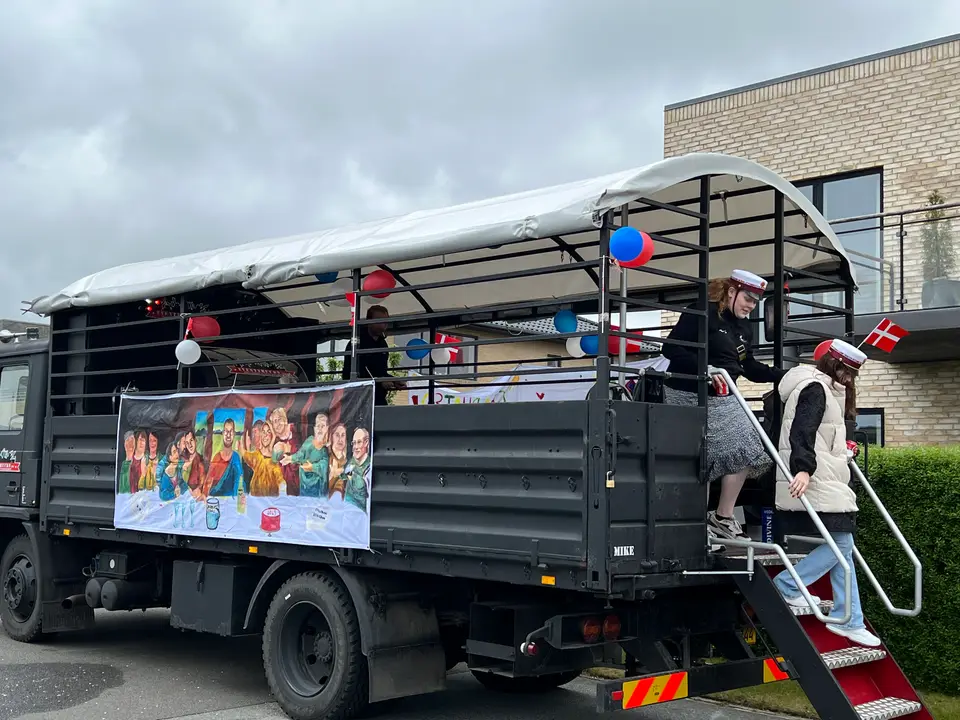
Legislation for student trucks
The law on graduation drives (eksamenskørsel)
Here you can take a closer look at the Danish executive orders that cover student trucks and graduation drives.
In short
The key rules for graduation drives
An overview of the main requirements in the Executive Order on Exam Drives (Bekendtgørelse om eksamenskørsel). The full text follows below – and our student trucks go beyond the minimum requirements.
- Only for students who have completed the final exam of an upper secondary education programme lasting at least 2 years (§ 3)
- The vehicle and its fittings must have been inspected and approved within 1 year before the drive (§ 5)
- Liability insurance covering personal injury to the passengers (§ 5)
- No more passengers than the truck is approved for (§ 5)
- No driving on motorways or expressways (§ 5)
- A maximum of 40 km/h in built-up areas and 60 km/h outside them (§ 5)
- Sides, front board and tailboard at least 120 cm high, measured from the platform floor (Annex 2)
- Solid, securely fixed seats for all passengers (Annex 2)
- At least one solid, non-slip set of steps for getting on and off (Annex 2)
- A powder fire extinguisher and a first aid kit must be carried during the drive (Annex 2)

In force: Executive Order no. 1322 of 28/11/2024
Executive Order on Exam Drives, Processions etc.
An unofficial English translation of the full Executive Order (Bekendtgørelse om eksamenskørsel, optog m.v.). Only the Danish text on Retsinformation, the official Danish legal database, is legally valid.
Pursuant to § 68(1), first sentence, § 83 and § 118(13), first sentence, of the Danish Road Traffic Act (færdselsloven), cf. Consolidated Act no. 1312 of 26 November 2024, and under the authority of § 3(1) of Executive Order no. 373 of 9 April 2024 on the tasks and powers of the Danish Road Traffic Authority (Færdselsstyrelsen) and the right of appeal, the following is laid down:
Scope
§ 1. The Executive Order applies to exam drives in which persons are carried on the load platform of vans, lorries or tractor-trailer combinations. The Executive Order also applies to procession drives in which persons are carried on the load platform of vans, lorries, semi-trailers or tractor-trailer combinations.
Definitions
§ 2. In this Executive Order:
1) Exam drive means the carriage of persons on the load platform of vans, lorries or tractor-trailer combinations in connection with drives after a final exam of an upper secondary education programme lasting at least 2 years.
2) Procession drive means the carriage of persons on the load platform of vans, lorries, semi-trailers or tractor-trailer combinations in connection with drives at carnival processions, town festivals, May Day processions and the like.
Exam drives
§ 3. Exam drives may only take place immediately after the completion of an upper secondary education programme lasting at least 2 years, and only persons who have completed the final exam of an upper secondary education programme lasting at least 2 years may take part in exam drives, but see subsections 2–4.
Subsection 2. Persons enrolled in an upper secondary education programme lasting at least 2 years who still have to complete one or more exams postponed due to illness may take part in exam drives.
Subsection 3. Persons who have completed the final exam of an upper secondary education programme lasting at least 2 years may take part in exam drives even if they did not pass the final exam.
Subsection 4. Persons who have agreed to extend an upper secondary education programme lasting at least 2 years may take part in exam drives after the end of the programme’s normal duration.
§ 4. Where a person covered by § 3 needs personal assistance because of special physical or mental needs, an assistant may take part in the exam drive.
§ 5. Exam drives may only take place if the following conditions are met:
1) The vehicle and its fittings must have been inspected and approved by a vehicle inspection company in accordance with Annexes 1 and 2 within 1 year before the drive takes place. If the vehicle is fitted with a swap body, the inspection company must submit photo documentation of the vehicle with the swap body electronically, on a form designed by the Danish Road Traffic Authority, through a system provided by the Danish Road Traffic Authority. The inspection company also hands the form with the photo documentation to the builder. The form must be carried during the drive.
2) At the time of the exam drive, no changes may have been made to the vehicle’s fittings or equipment compared with the approval under Annexes 1 and 2.
3) Liability insurance must be taken out covering personal injury to the persons carried during the drive.
4) During the drive, no more passengers may be carried than the vehicle has been approved for by a vehicle inspection company under Annex 2.
5) The exam drive must not take place on a motorway or expressway.
Subsection 2. Drivers of tractor-trailer combinations carrying out exam drives must hold a valid driving licence for a car with a large trailer (category B/E).
Subsection 3. The speed limits in force at any time must be observed. The speed must not exceed 40 km/h in built-up areas and 60 km/h outside built-up areas.
§ 6. During the drive, the driver must carry documentation that the conditions in § 5(1), nos. 1 and 3, are met and show it to the police on request.
Procession drives etc.
§ 7. Drives under § 1, second sentence, may only take place with permission from the police.
§ 8. Permission for drives covered by § 7 is granted by the Central and West Jutland Police (Midt- og Vestjyllands Politi).
Subsection 2. The police may decide to grant a single permit covering several police districts.
Subsection 3. A permit is granted for one or more vehicles, whose registration number and chassis number must be stated in the application.
Subsection 4. A permit is granted for one drive.
§ 9. After a specific assessment of the traffic conditions, including consideration for other road users and the passengers, the police may grant permission for drives under § 7.
Subsection 2. The police set the following conditions for the permit:
1) The vehicle and its fittings must have been inspected and approved by a vehicle inspection company within 1 year before the drive takes place. Inspection and approval must be carried out in accordance with Annexes 1 and 2.
2) At the time of the drive, no changes may have been made to the vehicle’s fittings or equipment compared with the approval under Annexes 1 and 2.
Subsection 3. As a condition for permission to drive with a tractor-trailer combination, the police require the driver to hold a valid driving licence for a car with a large trailer (category B/E).
Subsection 4. For the carriage of persons on a semi-trailer, the police set the conditions that the speed must not exceed 5 km/h (walking pace) and that stewards on both sides must accompany the vehicle and make sure that nobody gets on or off the vehicle during the drive.
Subsection 5. The police may set further conditions for a permit, including the vehicle’s maximum speed during the drive and route directions.
§ 10. The police permit must contain the following information:
1) The vehicle’s make, registration number and chassis number.
2) The owner’s and user’s name and address.
3) The police districts in which the permit is valid.
4) The time of the drive.
5) The type of drive covered by the permit.
6) The conditions of the permit.
Subsection 2. During the drive, the driver must carry the police permit and documentation that the conditions in § 9(2) are met and show them to the police on request.
§ 11. The police may revoke a permit if its conditions are disregarded.
§ 12. The drive must not take place on a motorway or expressway.
Right of appeal
§ 13. Decisions made by the police under this Executive Order may be appealed to the Danish Road Traffic Authority.
Subsection 2. Decisions made by the Danish Road Traffic Authority under subsection 1 cannot be brought before any other administrative authority, cf. the Executive Order on the tasks and powers of the Danish Road Traffic Authority and the right of appeal.
Exemptions
§ 14. The Danish Road Traffic Authority may grant exemptions from § 9(2), nos. 1 and 2, and subsections 3 and 4, where very special circumstances apply.
Penalties
§ 15. Anyone who violates §§ 3–7, § 10(2) or § 12 is liable to a fine.
Subsection 2. Likewise, anyone who disregards the conditions of a permit granted under this Executive Order is liable to a fine under § 118(1), no. 2, of the Road Traffic Act.
Subsection 3. Companies etc. (legal persons) may be held criminally liable under the rules in Chapter 5 of the Danish Criminal Code (straffeloven).
Entry into force and transitional provisions
§ 16. The Executive Order enters into force on 1 January 2025.
Subsection 2. Executive Order no. 1401 of 30 November 2023 on exam drives, processions etc. and Executive Order no. 375 of 18 May 2004 on the fittings and equipment of vehicles used for student drives, processions etc. are repealed.
Subsection 3. Applications concerning procession drives will be processed under the rules in force when the application is received.
The Danish Road Traffic Authority, 28 November 2024
Jacob Karkov Buch
Vehicle requirements
Annexes 1 and 2 to the Executive Order
Annex 1
A tail lift or hydraulic lift may be used for getting persons with reduced mobility on and off, provided the following are observed:
1) A clear marking must be placed on the platform 1.00 m from the tail lift or hydraulic lift, and nobody may stand between the marking and the tail lift or hydraulic lift while it is being operated.
2) It must be ensured that the tail lift or hydraulic lift cannot be operated by the passengers on the platform.
3) The tail lift or hydraulic lift may only be used for getting one person with reduced mobility, and possibly one helper, on or off at a time.
4) Wheelchairs must be properly secured on the tail lift or hydraulic lift when getting on and off.
Annex 2
For the drives referred to in §§ 5 and 9, the vehicle must be inspected and approved according to the following guidelines:
1) Vans, lorries and tractor trailers must have firmly fixed sides, front board and tailboard. The tailboard opening must have no fewer than two locks that prevent it from opening unintentionally while driving. The sides, front board and tailboard must be at least 120 cm high, measured from the floor of the platform. If the vehicle has seats along the sides of the platform, the sides must be raised by the seat height. If seats are placed in the middle of the platform, the sides must have 40 cm of screening without openings, measured from the floor of the platform. At the screening there may be a gap of 5 cm between the platform floor and the front board and tailboard, and between the platform floor and the lower edge of the sides. Horizontal openings in the sides, front board and tailboard must not exceed 25 cm. The gap between the platform floor and the front board and tailboard, and between the platform floor and the lower edge of the sides, must not exceed 5 cm. Vertical openings in the sides, front board and tailboard are not permitted.
2) The vehicle’s platform must have solid seats for all passengers. The seats must be securely fixed.
3) If the vehicle is to carry a person in a wheelchair, it must have brackets to hold the wheelchair in place. Wheelchair brackets must be firmly fixed to the vehicle.
4) The vehicle’s fittings under nos. 1–3 must be built to professional bodybuilding standards.
5) The number of passengers allowed on the platform is set by the vehicle inspection company and entered in the inspection report. It may be based on a seat width of 450 mm per passenger. This width may include up to 35 mm of free space on each side of the seat itself. Any spaces fitted out for placing and securing wheelchairs are also included.
6) There must be at least one solid, non-slip set of steps for getting on and off.
7) A tail lift or hydraulic lift must not be used for getting on and off and must be effectively secured against unintended use. However, a tail lift or hydraulic lift may be used for persons with reduced mobility under the rules in Annex 1.
8) Vehicles with a tipping body must be secured against use of the tipping body during the drive.
9) At least one powder fire extinguisher must be carried during the drive, placed in a suitable location that is easily accessible to the driver. The extinguisher must meet the requirements of EN 3-10 and must be serviced in accordance with the requirements of standard DS 2320:2020. The extinguisher must be approved and marked according to Danish Standard DS. It must also be approved and marked at least class 5 A, 34 B, but at least class 13 A, 89 B for vehicles fitted out to carry more than 19 persons.
10) A first aid kit must be carried during the drive.
11) The vehicle’s platform must be fitted out so that the passengers can leave the vehicle unaided in an emergency.
12) Tractor trailers must have at least 2 axles and steering.
13) The centre-of-gravity height of a loaded tractor trailer, whether single- or double-deck, must not exceed 90 per cent of the track width.
The driver’s working hours
Driving and rest time rules
The driving and rest time rules also apply on a graduation drive. That is why a 30-minute stop must be planned in your route plan.
Every Christmas one lucky class wins a free graduation drive
Follow us on social media
Follow us to see our content and join our competitions.